
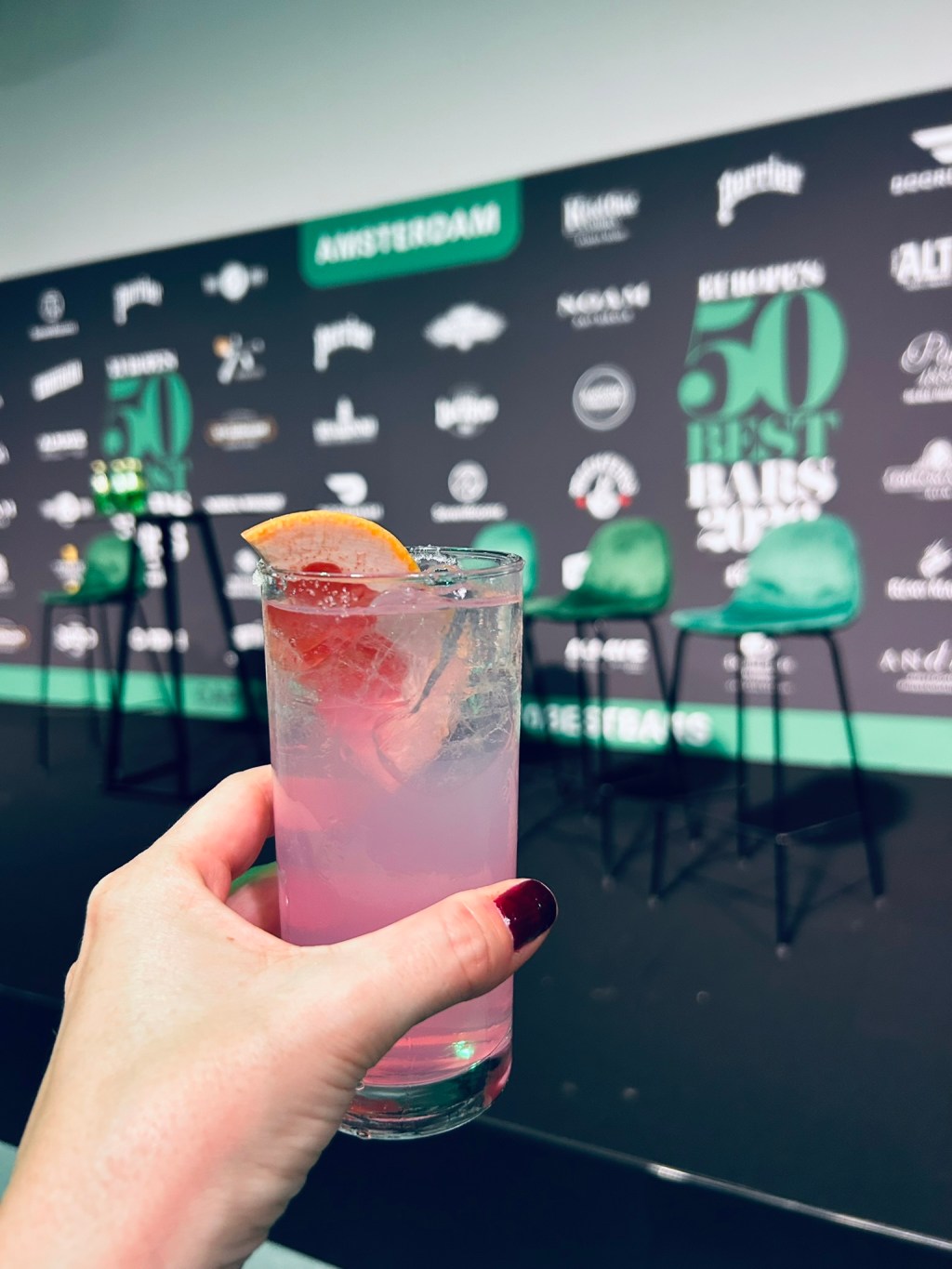

The launch of Europe’s 50 Best Bars marks a significant new chapter for the drinks industry.
While The World’s 50 Best Bars continues to set the global benchmark, this new regional ranking aims to shine a spotlight on the depth, diversity, and innovation emerging across Europe’s cocktail scene.
Following the inaugural awards ceremony, I spoke with Emma Sleight, Director of Creative & Content at 50 Best, about the motivation behind the launch, its relationship with the global ranking, and what it could mean for the future of bar recognition across Europe.
What was the main motivation behind launching Europe’s 50 Best Bars at this particular moment, and what gap are you trying to address compared to the global ranking?
According to Emma Sleight, the launch has been a long time coming. While cities such as London, Barcelona, and Rome have long dominated conversations around cocktail excellence, she believes Europe’s drinking culture is far richer and more diverse than many people realize.
‘The reason we launched Europe’s 50 Best Bars was that we genuinely felt it was a brilliant way to showcase more breadth and diversity across the region,’ she explains. ‘It is about celebrating established cocktail cultures, but it is also about exploring how drinking culture is evolving and being shaped in other parts of Europe.’
Sleight points to the rise of bars in Central and Eastern Europe, where operators are increasingly embracing local ingredients, endemic products, and regional craftsmanship instead of replicating trends from New York or London. Bars are developing experiences deeply connected to their local cultures, and voters are responding positively to that authenticity.
For her, the new ranking creates a broader platform to celebrate these emerging destinations and the unique identities that are reshaping Europe’s cocktail landscape.
How do you see the European ranking coexisting with The World’s 50 Best Bars—does it serve as a stepping stone, or does it reshape the hierarchy in its own right?
Sleight is clear: Europe’s 50 Best Bars should not be viewed as a feeder list for the global ranking.
‘The World’s 50 Best Bars and Europe’s 50 Best Bars will always be different because they are voted on by different academies, with different voting windows and different travel patterns,’ she says.
While outstanding bars may appear on both rankings, she rejects the idea that inclusion in the European list automatically paves the way toward a place in the global top 50.
‘We would never say that being in Europe’s 50 Best Bars is a guaranteed pathway into the world ranking,’ she explains. ‘It is about creating a geographical lens on a specific region.‘
Rather than reinforcing an existing hierarchy, the European ranking is intended to stand on its own, offering a dedicated perspective on excellence within the continent.
Do you expect the creation of regional lists like Europe’s 50 Best Bars to change the dynamics of the global ranking—for example by redistributing visibility or influence?
Sleight acknowledges that increased visibility is one of the most immediate consequences of a regional list. In fact, she considers it a success when consumers discover a bar they had never heard of before and decide to visit it.
‘If someone comments that they have never heard of a bar before and now want to travel there, that is exactly the kind of impact we hope to have,’ she says.
Greater recognition can attract international guests and increase a venue’s profile. Because voters remain anonymous, that exposure may eventually influence perceptions at a global level. However, Sleight stresses that there is no direct correlation between success in a regional ranking and future success in the world ranking.
‘It may affect visibility, but it is not a guarantee,’ she notes.
With global, regional, and now continental rankings, some in the industry say there may be too many lists competing for attention. How do you respond to concerns about oversaturation?
The question of ranking fatigue is one that Sleight readily addresses. She points out that 50 Best currently operates global and regional rankings, and that new lists are not launched lightly.
‘We do not launch new awards without a clear reason,’ she says. ‘There always has to be a strong rationale behind it.’
For 50 Best, the growing diversity of Europe’s bar scene justified creating a dedicated platform. Rather than competing against one another, Sleight sees the various rankings as serving distinct purposes.
‘I think they give different geographical areas opportunities to shine in ways that they might not on the global stage,’ she explains. ‘We see them as complementary rather than combative.’
That philosophy also extends beyond the rankings themselves. Initiatives such as 50 Best Discovery, editorial features, and independent awards like SevenRooms Best Bar Design Award provide additional opportunities to spotlight venues that may not appear in the rankings.
Looking ahead, do you see these regional rankings as a way to make the system more inclusive and representative, or do they risk reinforcing the same patterns on a smaller scale?
Sleight remains optimistic about the long-term impact of regional rankings. She points to the evolution of Asia’s 50 Best Bars as evidence that these lists can become increasingly representative over time.
‘When Asia’s 50 Best Bars launched, most of the bars were concentrated in established cocktail capitals such as Singapore, Hong Kong, and Tokyo,’ she explains. ‘Today, we are seeing recognition for communities in places like Kumamoto, Goa, Bengaluru, and Phnom Penh.’
For Sleight, this demonstrates how regional rankings can help uncover emerging scenes and encourage their development. She also suggests that future expansions, including a potential 51–100 ranking, could further widen the spotlight and bring even more destinations into the conversation.
‘Our hope is that these rankings will help showcase and support new cocktail communities in the years ahead,’ she says.
***
For Emma Sleight, the creation of Europe’s 50 Best Bars is not about adding another layer to an existing hierarchy. Instead, it represents an opportunity to celebrate the extraordinary diversity of European cocktail culture at a time when innovation is flourishing far beyond the continent’s traditional bar capitals.
From Bratislava to Athens, from Budapest to emerging destinations yet to gain international recognition, the inaugural list reflects a broader shift within the industry: a growing appreciation for local identity, authenticity, and originality. Rather than competing with the global ranking, Europe’s 50 Best Bars seeks to complement it by highlighting stories that might otherwise remain overlooked.
If the first edition is any indication, the new ranking may prove less a reflection of the established order than a catalyst for discovering the next generation of Europe’s most influential cocktail destinations. Yet despite the appetite for more data from some industry professionals, Sleight made it clear that 50 Best does not disclose vote totals for individual bars. She acknowledges the interest in more detailed data but emphasises that the organisation’s priority remains celebrating excellence across the industry and helping consumers discover outstanding venues around the world. In keeping individual vote counts private, 50 Best aims to keep the spotlight on recognition, storytelling and exploration, rather than encouraging direct numerical comparisons between venues.
Ultimately, her ambition for Europe’s 50 Best Bars is simple: to encourage professionals and consumers alike to look beyond the obvious, explore new destinations, and celebrate the remarkable diversity that continues to redefine Europe’s cocktail culture!
Thank you Emma 🙂


Leave a Reply